Best AI video detectors for 2026: how to detect AI-generated videos?
It seems strange, but only 2 years ago we didn't even need AI video detectors.
In 2019 the first AI video (in a modern understanding) was made. It was odd to see it and, bet, a general viewer could never expect what's going to happen in the span of a few years. And do you remember those Will Smith's spaghetti videos of 2023? 2 years later the progress seems incredible. But this is our reality and the further we go, the better the AI will become.
You can check our Explore page where we gather the most viral and shocking AI content from social media. And as the amount of AI-generation tools grows, the arms race speeds up. It feels like there's an AI video detector for each AI video creation model…
How to keep track of every AI video detector out there? And which one is the best? Let's see what the modern market can offer and analyze every option's pros and cons for AI video detection in 2026. But firstly, let's figure out…
Why do you need AI video detection in 2026?
AI-generated videos are everywhere. From Hollywood-quality deepfakes of celebrities to bogus clips of disasters and crimes, AI video threatens truth, trust and safety online. Many users share that they don't know how to detect AI-generated videos. The stakes for 2026 AI video detection are sky-high, as media literacy is vanishing and scammers reign supreme. The World Economic Forum reports: 'deepfake attacks have evolved into precision weapons targeting corporate operations'. It's not just silly internet hoaxes anymore.
Here are some of the AI-generated video examples:
-
Financial fraud
Business insiders are getting burnt. In one high-profile case scammers used a fake video conference with a CEO to siphon $25.5 million from an engineering firm.
Another finance employee in Hong Kong authorized $39 million after a deepfake CFO urgently requested a transfer.
One of the recent cases captured deepfake Nvidia CEO Jensen Huang in a fake YouTube stream from GTC garnering 100,000 viewers. The deepfake urged viewers to participate in a bogus crypto distribution scheme. Luckily, no victims reported, still it doesn't mean there weren't any.
Businesses that do not integrate AI detection tools into their workflows lose on average around $500,000. So, their concern is very understandable: how to check if a video is AI generated?
-
Misinformation and panic
These financial scams are far from the only AI-generated content (even though it's probably the most dangerous one). Social media is flooded with AI-generated tsunamis, landslides, animal clips, fake political videos and many many more other types of fakes. There're so many of them that it seems we could've trained our AI video detector non-stop.
Why is it bad? Viral AI videos spread misinformation. Initially they are produced to gain followers and hype on buzzing news, but eventually lead to broken trust and rising anxiety. Media outlets might take those videos from the Internet and give them even more online virality. People of the older generation are at the greatest risk here as it is usually harder for them to navigate properly in a modern tech world and notice those fine points that help to tell fake from real. AI clips can sway public opinions and even incite violence. Detection is not just recommended but essential.
This video gained more than 2.5M views on X. People in the comments split into two camps: those who believed it and those who said it was AI.
Source: X post -
Legal and personal harm
Let's not forget personal and legal harm. Deepfakes can ruin reputations (by different ways) and celebrities, politicians, and even ordinary folks are potential victims of blackmail, smear campaigns, or humiliating revenge material crafted by AI. These nightmare scenarios are offered as if they're already the norm. No, they're not. And we are here to fight for it.
So, seeing is no longer believing. Yes, AI is officially here and we're afraid you can't do without an accurate AI video detection tool anymore. The only scalable defense is automated AI detection that will check if the video is AI-generated. By a happy coincidence, we've got something to offer :)
What is an AI video detector and how does it work?
So, what does it mean to check if a video is AI-generated? An AI video detector is a tool that analyzes a video clip and judges if it's authentic or AI-generated. Under the hood, it's powered by advanced algorithms in computer vision and machine learning. To build an AI video checker we fed it with huge data sets of both real and fake videos. It's learned to spot AI-generated clips and notice those tiny details that generation models are meant to hide.
This is a brief outline on AI video detection. More details are in our article on how to use a video detector. Check it out for more facts and features!
The best AI video detectors for 2026 (compared)
We evaluated the top AI video detectors of 2025 on key metrics to help you choose the right tool 😉
Below is a comparison table including their accuracy, speed, multimodality, API and free plan availability, interface, and report style. Please, notice that we focus on video detectors here. Some tools detect images or audio too, but our table is about video deepfake detection.
| Tool | Accuracy (%) | Speed | Multimodality | API | Free plan | Interface | Report type |
|---|---|---|---|---|---|---|---|
| isFake.ai | 97 | Fast (seconds) | Yes | Yes | Yes | Web, API | Score + flagged frames + report |
| Intel FakeCatcher | 96 | Fast | No | No | No | GUI, research | Graphical (flow analysis) |
| Sensity AI | 95 | Medium | Yes | Yes | No | Web, API | Summary + report |
| Reality Defender | 92 | Medium | Yes | Yes | Yes (limited) | Web, API | Score + indicators |
| TrueMedia.org | 90 | Medium | No | No | Yes (limited) | Web | Score + links |
| Attestiv | 85 | Slow | Yes | Yes | Yes (trial) | Web | Report + analysis |
| Amber Video | 85 | Medium | No | Yes | No | Web | Score + Confidence |
| Hive AI | 83 | Medium | Yes | Yes | No | Web, CLI | JSON / summary |
| Truepic (Video Authenticator) | 80 | Medium | No | Yes | No | Web, API | Watermark check + score |
Table: Comparison of leading AI video detectors in 2025.
Yeah, we hope that table actually makes sense. But let's break down the details and take a look at every AI video detector separately.
Intel FakeCatcher
Impressively fast and specialized tool for deepfake detection. You can't ‘use’ it in a common sense for video detection, but it operates on Intel Xeon processors for real-time detection in video streams.
Key features:
- Uses biological signals (like subtle blood-flow patterns in faces).
- Great speed parameters. Near real-time.
- Accuracy claims hover around ~96% in controlled environments.
With respect to all of the achievements, that's probably not the best option for everyday users asking ‘is this YouTube video AI?’. Intel FakeCatcher is not a public web tool and it doesn't offer a free plan either. Still, it's a great solution for AI video detection in live streams, security systems, and experimental deployments.
Sensity AI
Sensity AI is widely recognized as one of the most accurate deepfake detection platforms in 2025.
Key features:
- One of the highest claimed accuracy ranges (~95–98%). A great score!
- Deep forensic analysis across video, audio, and metadata.
- Used by media orgs, platforms, and investigators.
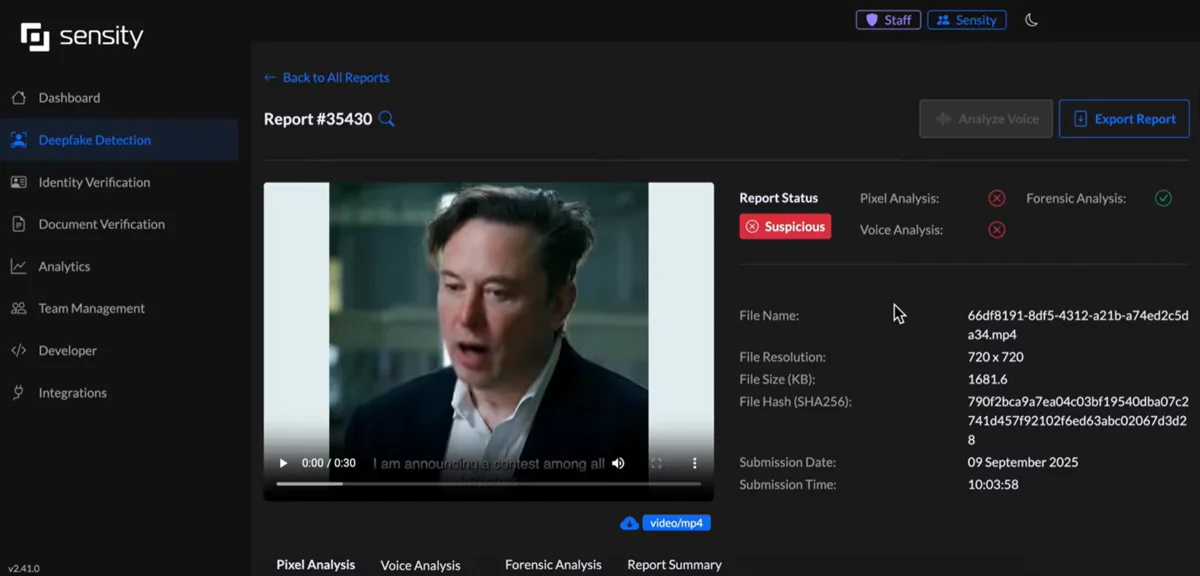
But again, Sensity AI might be an overkill for casual checks. Doesn't support a free plan and is set up more for enterprise level.
Reality Defender
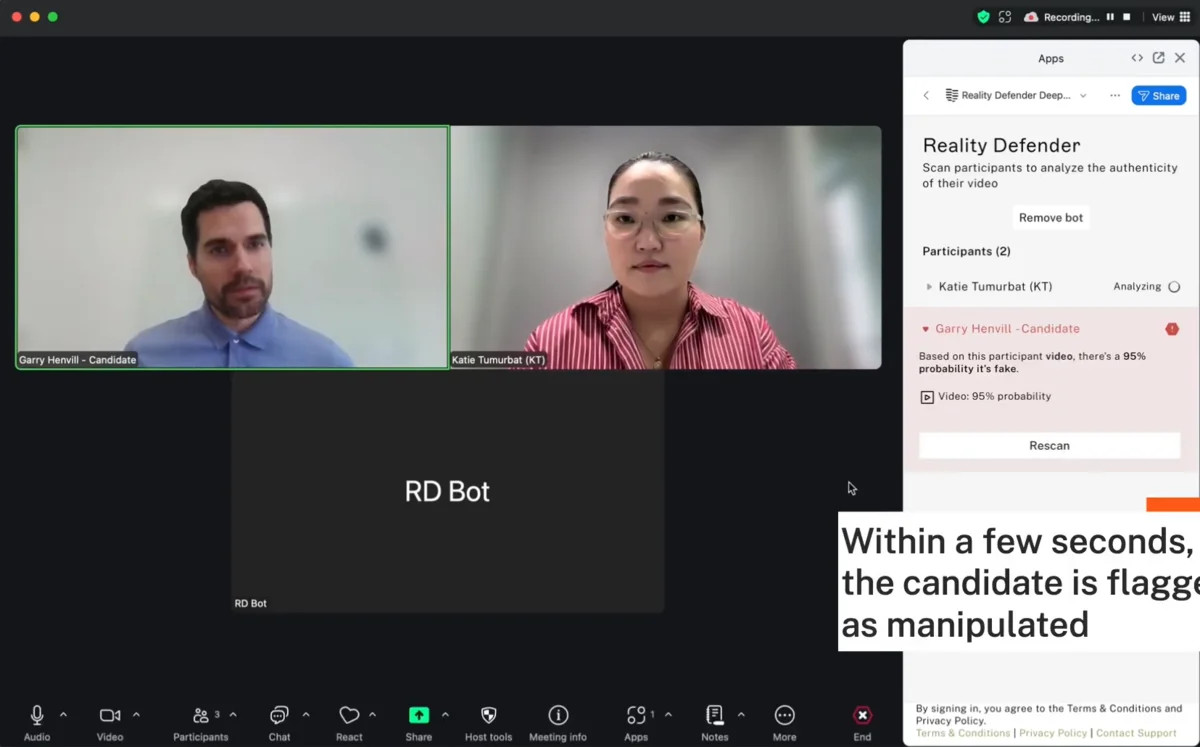
A nice tool that's easy to integrate in different workflows. Checking for deepfakes in Zoom calls online never was easier!
Key features:
- Accuracy typically lands around 90-95%.
- Offers a limited free plan.
- Supports video, image, audio, and text detection.
- API available.
TrueMedia.org
TrueMedia.org is a free, non-profit ensemble detector using multiple AI models, reported at ~90% accuracy. It is currently transitioning and expected to relaunch soon. Will see which updates they are going to make!
Key strengths:
- Non-profit project.
- Uses multiple detectors and averages the results.
- Accuracy around ~90%.
- Fully free.
While it can be a great option for journalists, educators, and researchers on a budget, high-speed or high-volume AI video verification is questionable. At least until the relaunch :)
Attestiv
Attestiv focuses on forensic analysis with a suspicion score and can embed media fingerprints for authenticity tracking.
Key features:
- Focuses on forensic analysis and chain-of-custody.
- Produces suspicion scores and evidentiary reports.
- Used in legal or investigative contexts.
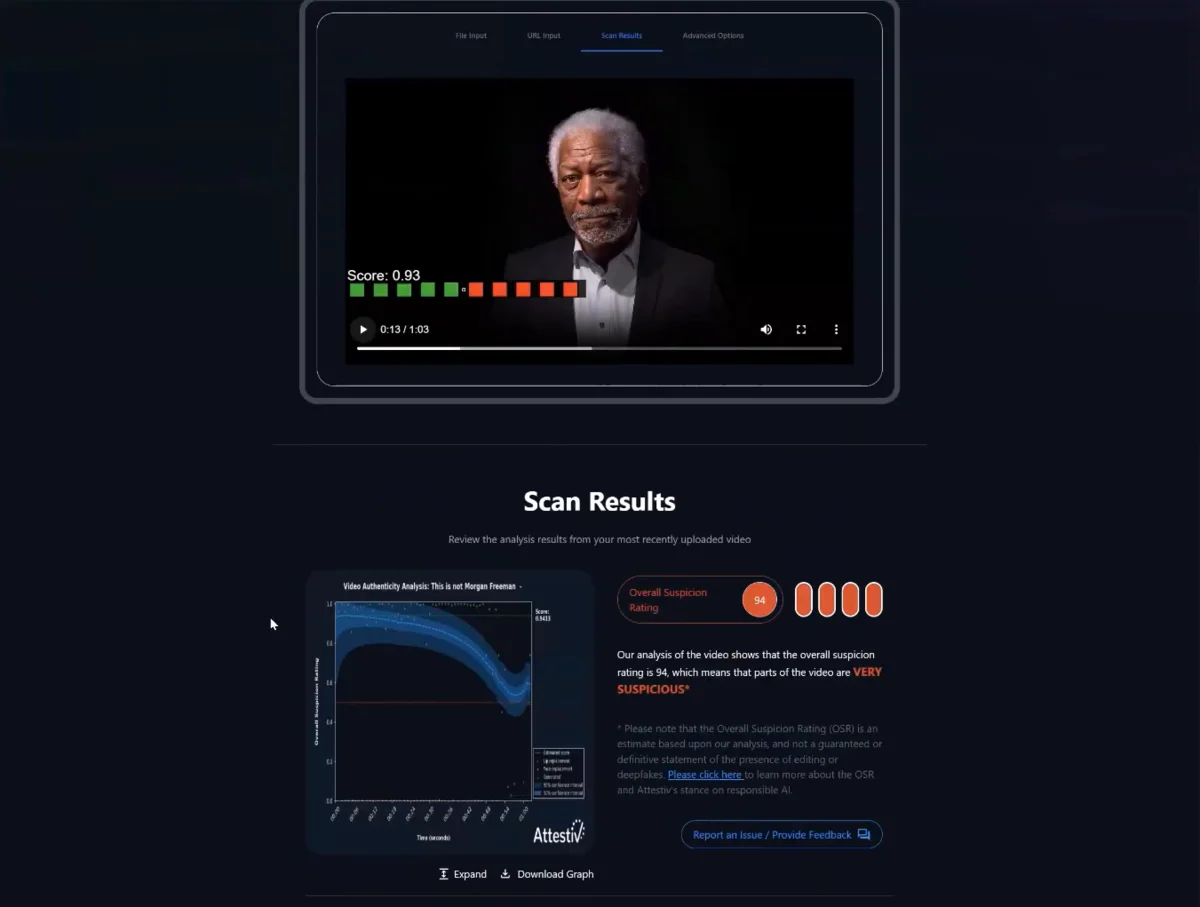
Again, this tool is great and useful, but that's not a simple 'is this video AI?' type of checker. It's not optimized for casual users and is considered to be something from the same road, but a different lane, you know.
Amber Video
Amber builds a trust layer under video at the moment it's captured. It hashes video segments and stores those hashes (e.g., on a blockchain). If anyone alters the file later, the hashes won't match anymore. It's more like a tamper alarm than an AI detector.
Key features:
- Cryptographic fingerprints (yeah, that's those hashes).
- Best when embedded into capture hardware or apps, not just uploaded after the fact.
- Accuracy score around ~85%.
Sounds cool, really, but that's not a standalone deepfake detector. It proves integrity, not AI origin and works really great only when the system is installed at the source (e.g., bodycams, CCTV), not for random YouTube uploads.
Hive AI
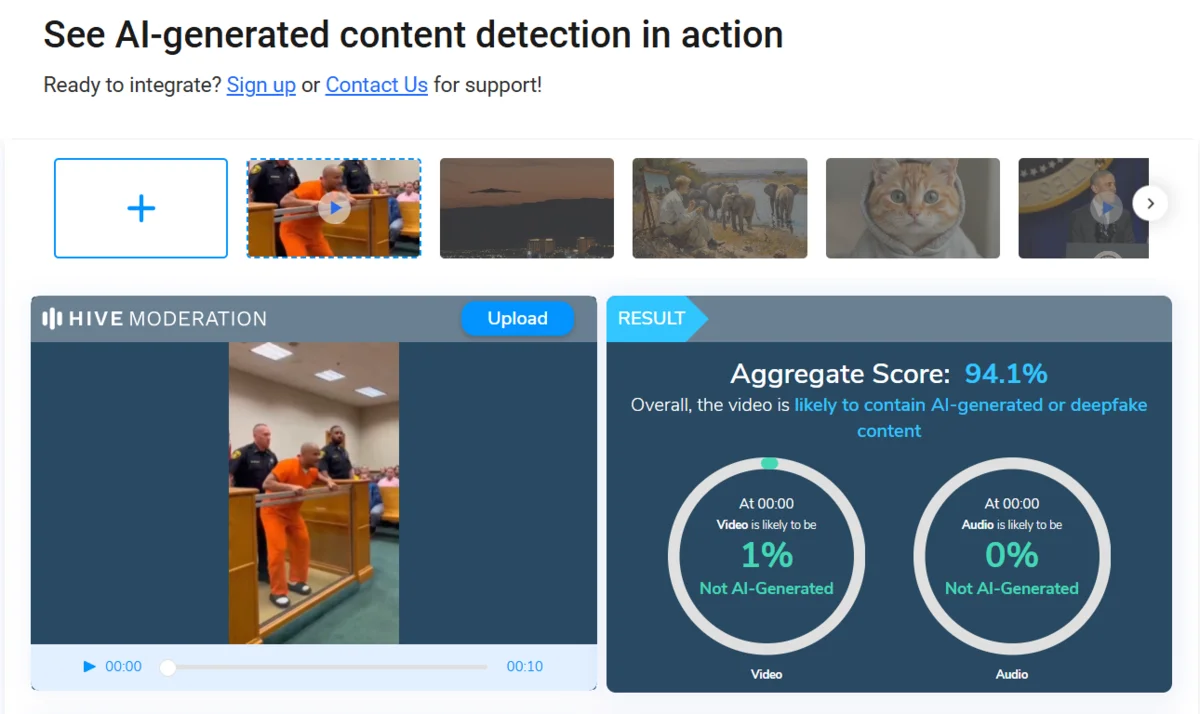
More of a moderation-focused detector, rather than a tool for deep analysis.
Key features:
- Accuracy around 85-90%.
- Strong API.
- Designed for content moderation at scale.
However, among its cons: superficial checks and the lack of comprehensive reports. Why is the video AI? What parts are AI-generated? Is it fully AI-made or just AI-edited? These questions might go unanswered.
Truepic (Video Authenticator)
It's a visual authenticity suite that verifies where, when, and how a photo or video was taken by embedding secure metadata and cryptographic signatures at capture time. Somehow close to what Amber does.
Key features:
- It verifies time, location, device info, and capture integrity.
- The media is sealed so (even the tiny) changes show up later.
- Truepic's tech is embedded in workflows and even in Snapdragon chips for on-device signing.
Again, Truepic's not a reactive deepfake scanner: it shines when media is captured with provenance features. If you need to check whether that suspicious wildlife TikTok is AI, it's better to use something different…
isFake AI Video Detector
isFake AI video detector seems to be a flawless tool for both casual checks and workflow integration.
Key features:
- ~95-98% accuracy.
- Frame-by-frame analysis, that highlights the most suspicious fragments of the video.
- A comprehensive report after each detection. You can check the audio and separate frames.
- Free plan available.
- The only multimodal tool that gathers together 4 (FOUR!!!) AI detection models – video, audio, images and text!
Our AI video detector is a perfect tool for journalists, entrepreneurs, educators and general users that want to know whether the video is real or fake. isFake user-friendly interface adds comfort to the AI detection process, and our cheerful mascots are always near to help you with the video authenticity check.
False positives: the #1 AI video detection problem
A major headache with detectors are false negatives (when AI-generated videos do not get flagged) and false positives (when real videos get flagged as AI). While the phenomenon of false negatives is easier to understand, false positives are more complex and troublemaking.
Imagine 2 scenarios: in the first one a fake video gets flagged as AI by a majority of detectors except for one. For a user this will likely mean that the video is actually fake, but the last detector just made one mistake.
The second scenario mirrors the first one vice versa. The real video gets flagged as AI only by one detector. Again, only one mistake by a detector, but the user's trust is immediately undermined. One false positive in AI video detection weighs more than one false negative, and it might make a difference.
Why does this happen? Advanced AI can produce clips that look more uniform than real human recordings. A sharply-shot interview or movie clip might be extremely clean and consistent, which detectors sometimes misinterpret as 'too perfect' and therefore suspect. Conversely, a jerky amateur recording can confuse a model into thinking it's AI. In short, there's overlap between subtle real video quirks and AI artifacts.
We built isFake.ai with both false positives and false negatives in mind. We made our model go through millions of videos that also included non-obvious examples of both real and fake clips. Constantly we work on the development of our model's AI video detection accuracy. We keep on teaching it on huge updated datasets, making it detect AI-generated videos, so even the newest gen AI models have issues with isFake. But even the biggest datasets can't guarantee no mistakes at all. So we developed the most transparent way of evaluating the detection result.
Confidence score, frame-by-frame analysis and a complex report after each detection.
This is what makes isFake AI video checker different. We do not simply judge the content, but display the model's confidence that the video is actually AI. Frame-by-frame analysis becomes an irreplaceable feature for the videos that are only partially generated.
Source: X post
This particular example shows a compilation of videos, some of which are actually AI-generated, but not all. The video detection tool handles the task and highlights the most suspicious parts of the clip. Additionally, in the Report we get the full break-down of video fragments with the separate confidence scores for each one of them. This video is officially fake, but only partially.
So, yes, false positives and false negatives occur indeed. Unfortunately, there's no other way of detecting fakes because as soon as AI detector accuracy reaches 100% it would mean that generative AI lost the race. Well, maybe one day…
But what we do for now, is trying to reduce the number of errors to the possible minimum. And it seems like isFake AI succeeds in this.
So, which AI video detector is the best in 2026?
Not to brag, but our AI video detector stands out among its competitors:
- Accuracy of video detection is high and constantly strives higher as we further teach the model
- Levels of false negatives and false positives are continually decreasing (in particular, because of the growing accuracy level). Yeah, so basically those things are intertwined…
- No certain verdict ‘AI’ or ‘Human’ allows you to analyze the detection result and see if the video is fake, partially edited or real. Confidence score (%) and frame-by-frame analysis are your BFFs in the world of fakes
- User-friendly interface is created because we love you and want it to be useful and convenient for you ❤️
- We know how important it is to be fast in the modern media. It takes seconds for our detector to check even the longest videos.
How to detect AI-generated videos for free?
You don't need a PhD in computer science to check if a video is fake. With isFake.ai, it's literally a few clicks:
- Upload your video. Go to isFake AI video detector and drag your file (MP4, MOV, etc.) into the detector.
- Let us do the job. Hit 'Check video' and blink. Maybe two times. Yes, the result is already here! The score below displays the model's confidence that the video is actually AI-generated. The most suspicious fragments of the clip are highlighted in the frame-by-frame analysis. Press 'Report' for an extended break-down of the video detection result.
- Read the results. Based on the score you got and all the highlighted frames it's possible to make a conclusion about the original video. 50-70% usually mean that the video is partially AI-edited, while 70-100% highlight fully generated masterpieces.
More about detection results – here.